Column View
Item record
Reuse
McAnany, Patricia A., 2004. Pottery Vessels Database for K'axob: Ritual, Work, and Family in an Ancient Maya Village. Version 2. Cotsen Institute of Archaeology Press. https://doi.org/10.25346/S6/S0V2FO
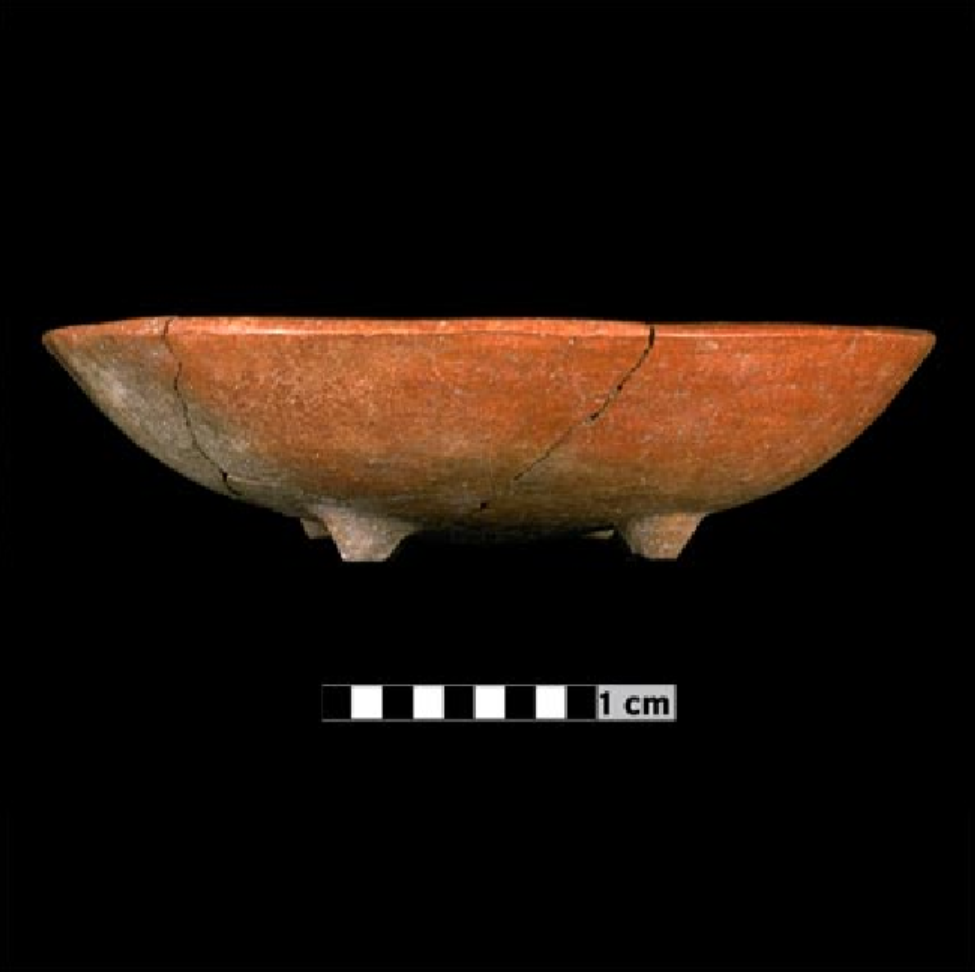
One of two similar vessels (with V# 082), the bowl has round incurving sides, a round base, and a direct round lip. Four nubbin feet were added after the vessel was formed and provide support (unlike V# 082). The nubbins are each 1.5 cm in height. Red (2.5YR 5/8) slip covers interior and exterior surfaces, and the paste is a yellowish red (7.5R 5/8). The bowl was the upper vessel in a lip-to-lip cache.
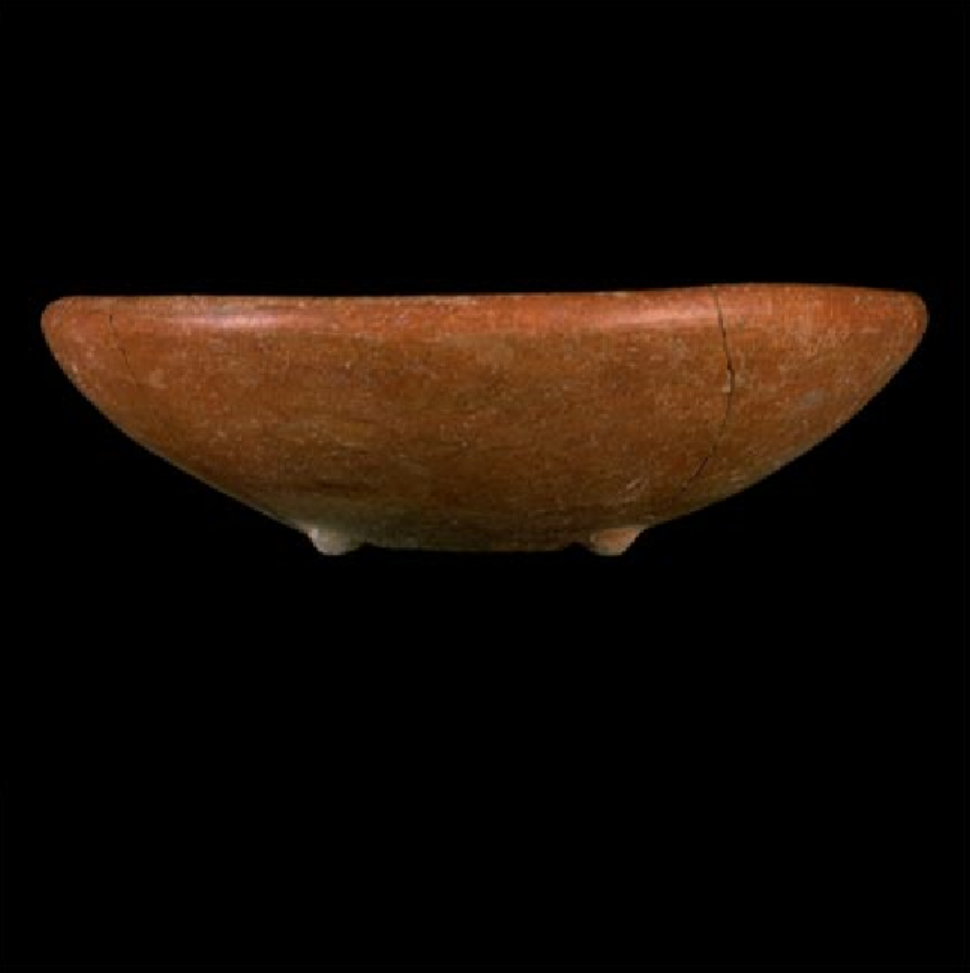
The second of two similar vessels (with V# 081), it is a rounded bowl with a slightly incurved rim and four nubbin feet. The feet (0.8 in height) were added after the vessel was formed and do not support the body. Red (2.5YR 4/8) slip covers the interior and half of the vesselÕs exterior. The paste is gray (10YR 5/1). This bowl was the bottom vessel of a lip-to-lip cache.
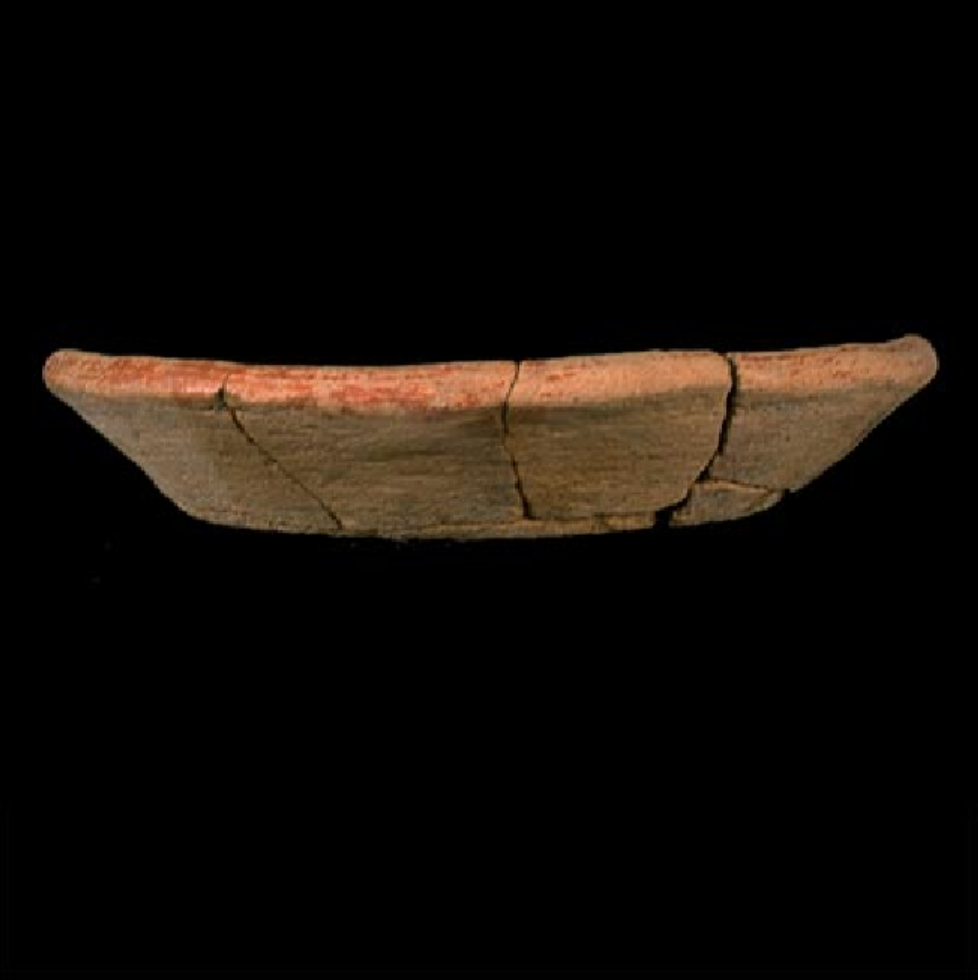
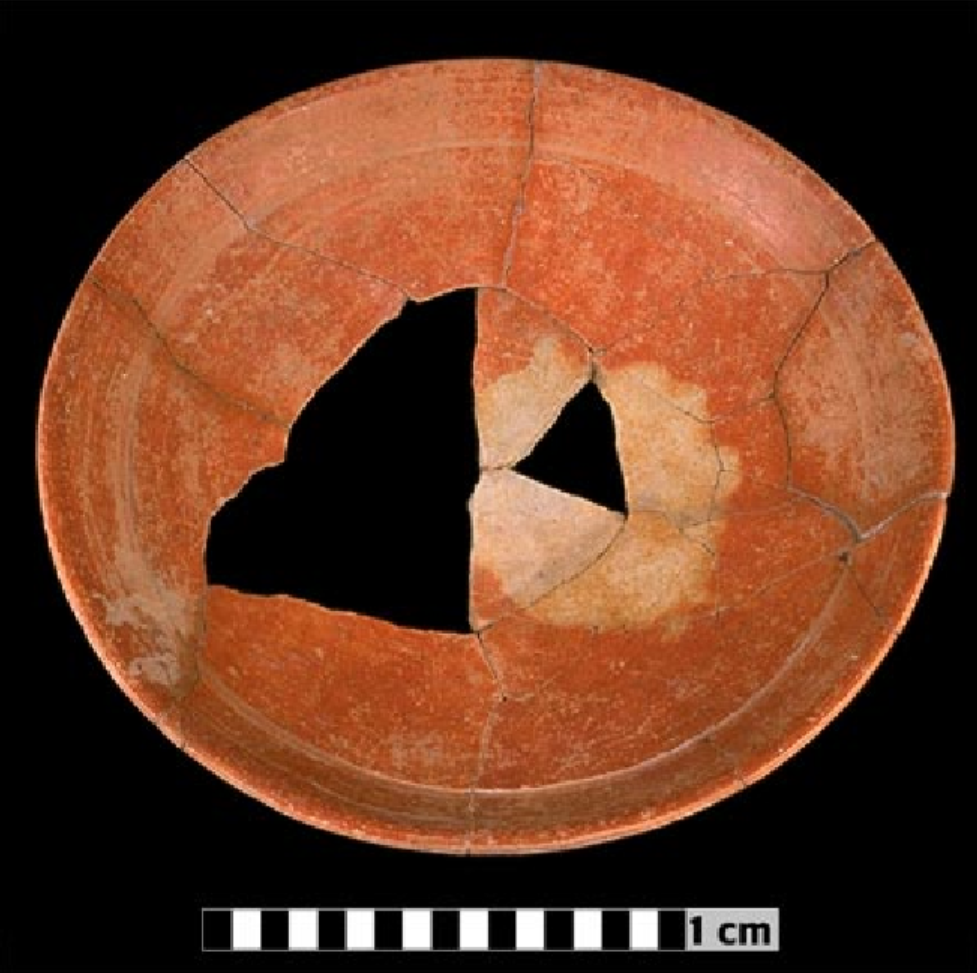
Dish with outcurving walls and a direct rounded lip. Eroded red (10R 4/8) slip is present on the interior. The paste has a dark gray (2.5YR 4/0) core. The flat base measures 10 cm in diameter. Wall thickness is 0.3 cm, but widens to 0.7 at the rim.
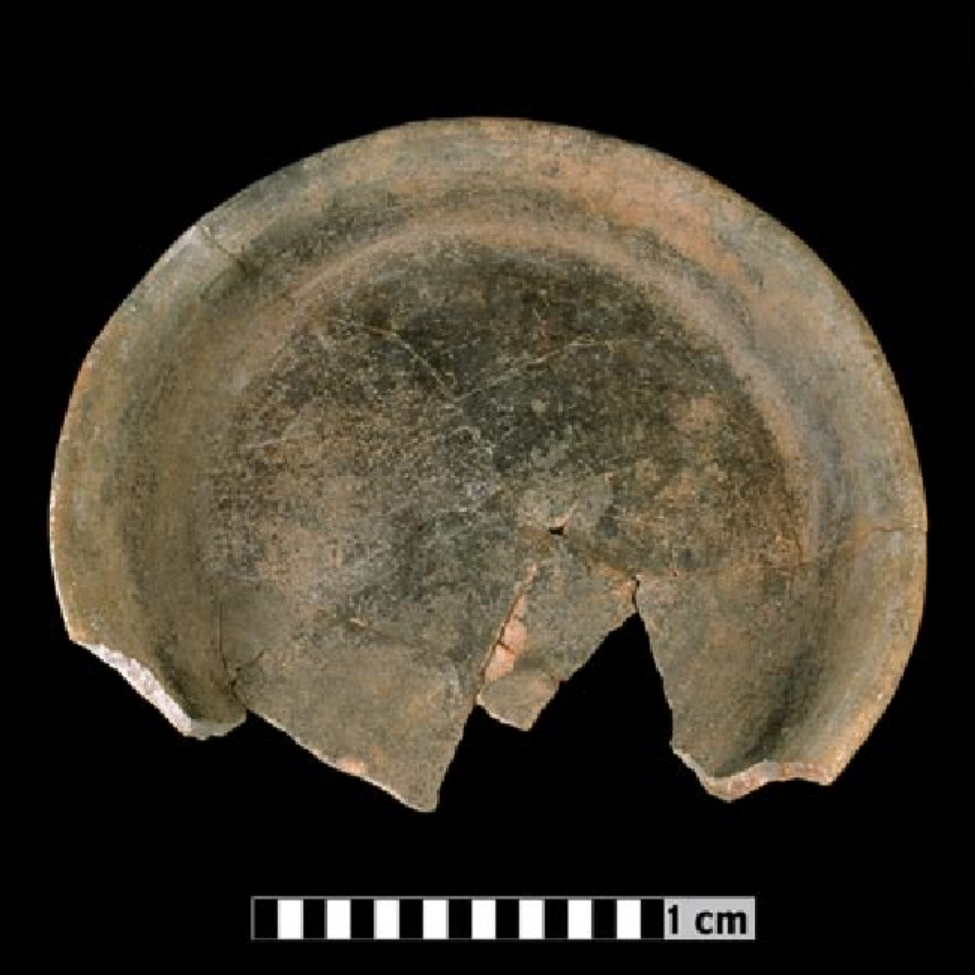
A dish with outcurving sides and a flared, everted rim. The flat base is 18.5 cm in diameter. The paste is finely textured with a 1-cm thick blackened core. Fire clouding occurs on the surface in variable colors: a very pale brown (10YR 7/3), dark gray (2.5Y 4/0), black (2.5Y 2/0), and red (2.5YR 5/6).
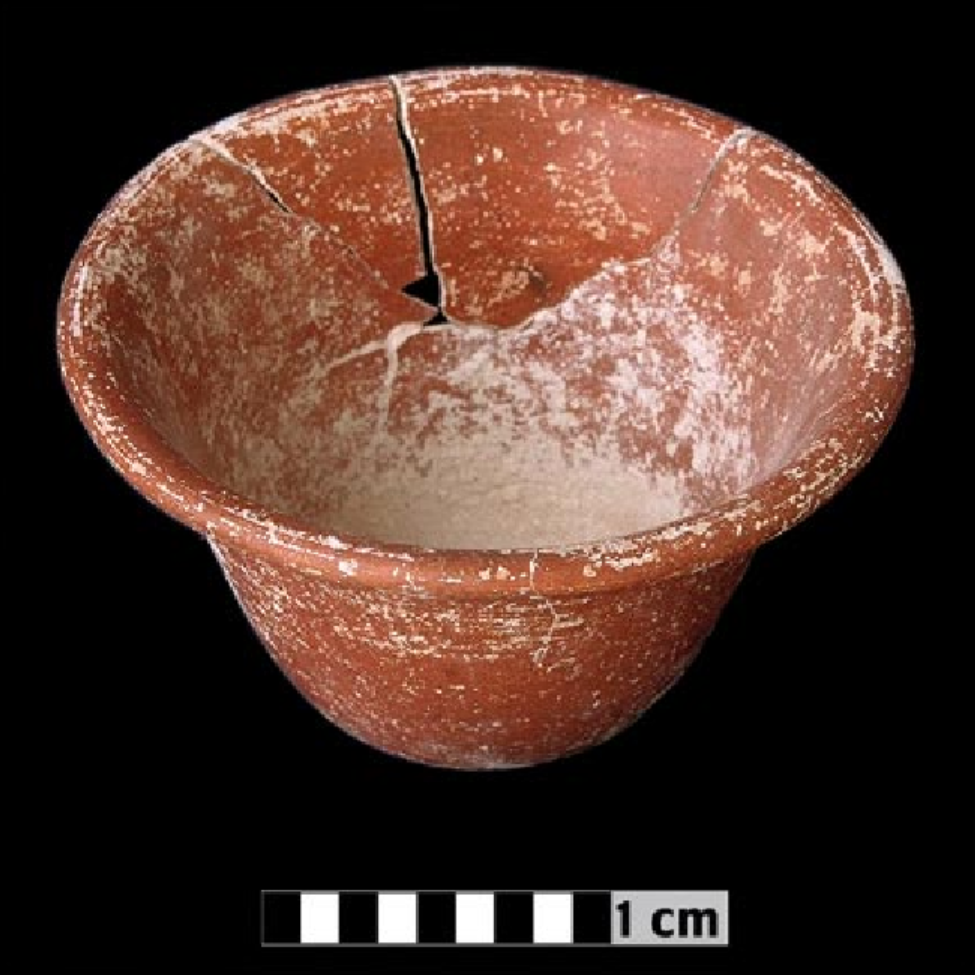
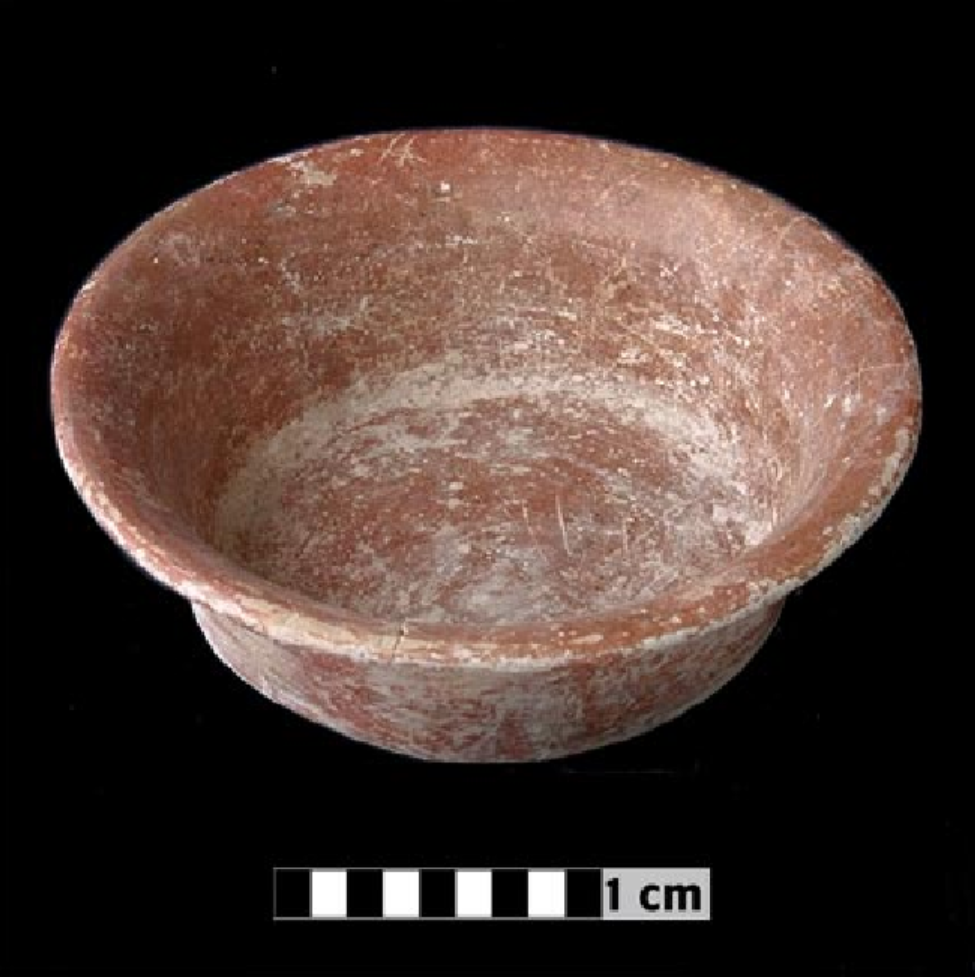
Slightly flaring, this bowl has an everted rim and a rounded lip. It is slipped on the interior and exterior in red (2.5YR 4/8), but fire clouding occurs on the exterior. The paste is red (2.5YR 5/6) and has large white inclusions. The base has a diameter of 10 cm.
A bowl with incurved sides, slightly concave base (13.5 cm diameter), direct rim, and rounded lip. The vessel has pronounced circumferential angular ridges of 3 cm. There are two chamfers that begin at the rim. The first measures 2 cm in width, the second 3 cm. Slip is present on both the exterior and interior in a typical Sierra Red hue (2.5YR 4/8). Fire clouding occurs in gray (2.5YR 6/0) and light gray (5YR 7/1). The paste has a fine texture and a reddish yellow (7.5YR 6/6) color.
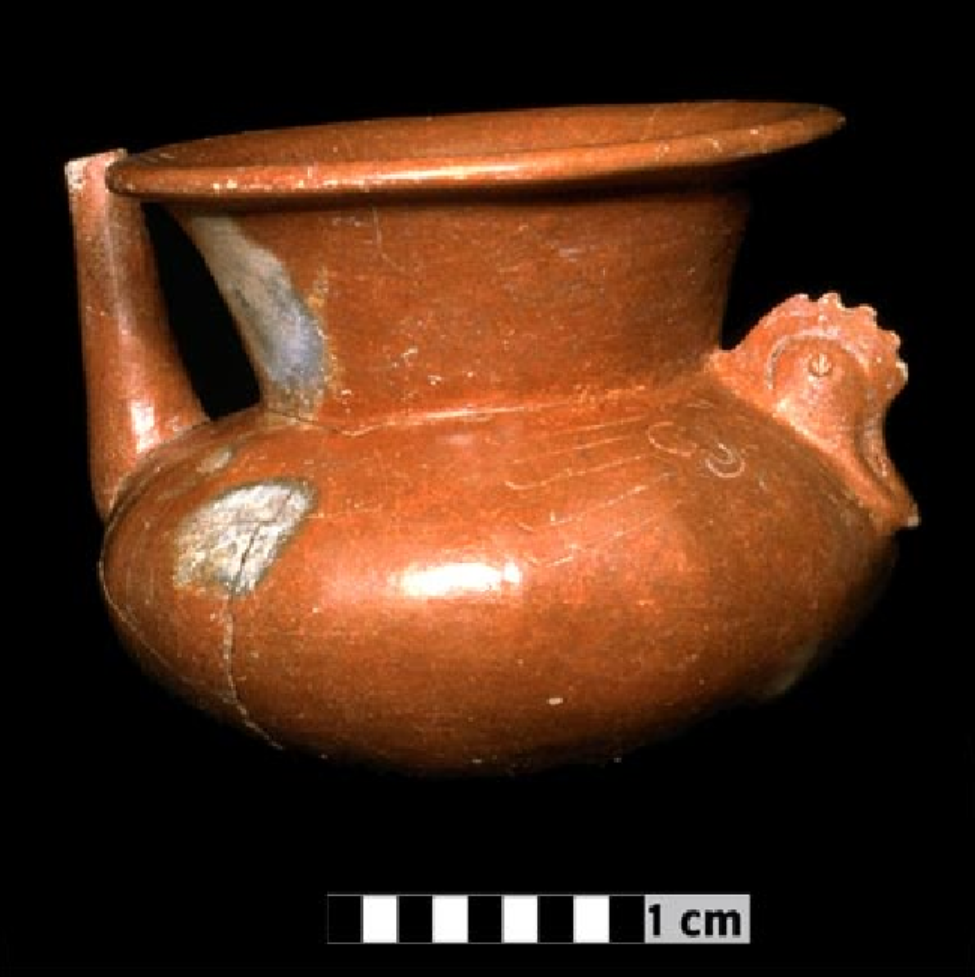
A Sierra Red effigy jar with incurved-outcurved sides, a long neck, and an unsupported spout. The spout is located opposite the modeled duck head effigy. There are incised lines representing the wings of the duck on either side of the vessel. The height of the vessel neck is 7.5 cm and the rim is horizontal and slightly everted. The spout measures 13.5 cm in height and its orifice is 0.7 cm in diameter. The color of the surface falls within the Sierra Red color attributes (2.5YR 4/8). Fire clouding is either gray (2.5YR 6/0) or light gray (5YR 7/1). A reddish yellow (7.5YR 6/6) color characterizes the finely textured paste.
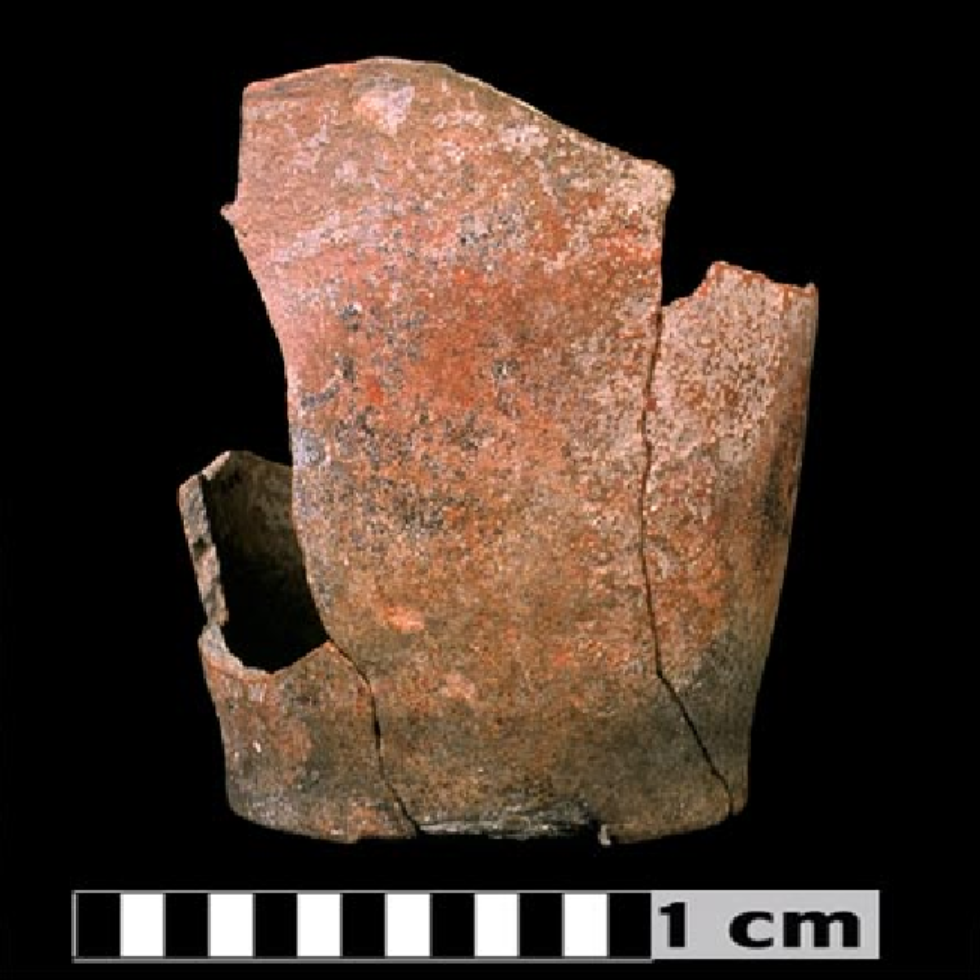
A cylinder form with slightly incurved-outcurved walls at both the base and top. No rim sherds were found. The flat base is 12 cm in diameter and the thickness of the wall is 0.5 cm. The slip is eroded and blackened. This vessel is so fragmentary, accurate dimensions are not possible. The height of the largest sherd is 17.5 cm.
Very friable and in numerous pieces, this dish has outcurved, rounded walls and a direct but rounded lip. It is slipped in red (2.5YR 4/8) on the interior and exterior. The paste is moderately coarse with a yellowish red (5YR 5/8) exterior and a very dark gray (5YR 3/0) core. The thickness of the base is 1.5 cm. This dish was found upright in the lap of a seated individual.
DOA No: 33/200-5:15 A Sierra Red bowl with flared walls, an outcurved, everted rim, and a rounded lip. The bowl has a flat base of 18.3-cm diameter. Wall thickness is 1.2 cm. The paste is very fine. Fire clouding occurs on the surface of the vessel in the following colors: very pale brown (10YR 7/3), dark gray (2.5Y 4/0), black (2.5Y 2/0), and red (2.5YR 5/6).
Eroded and very fragmentary, this Sierra Red bowl flares from a flat base of 24-cm diameter. The paste and color are characteristic of Sierra Red. The vessel was found inverted over the head and torso of a seated, old adult female.
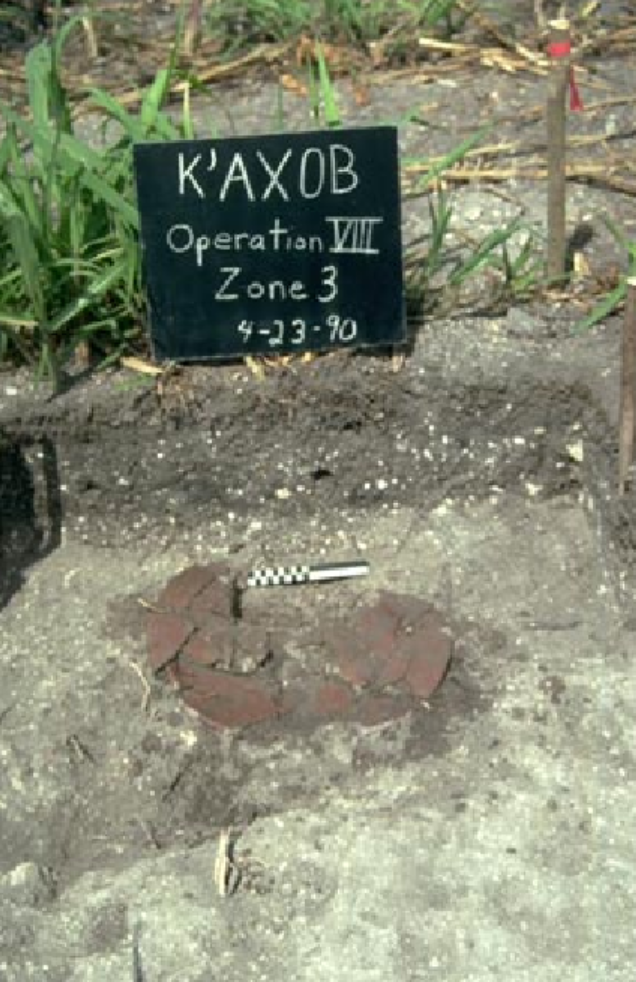
Construction Phase 4, Vessel #092 in situ, associated with Burial 12-12, view to west.
A dish with flaring sides, an outflared, everted rim, and a rounded lip. The base is slightly incurved and measures 33 cm.
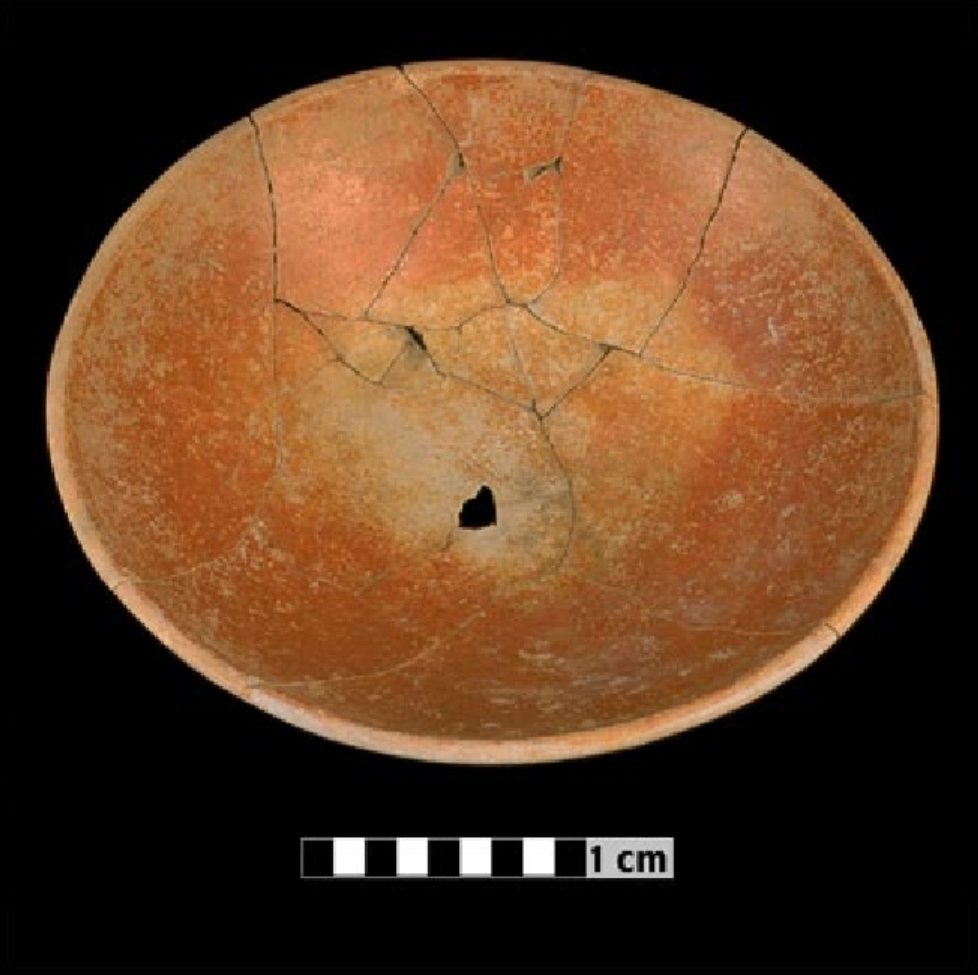
Vessel: Sierra Red: Sierra Variety dish from a cache-like context with human skeletal remains.
An Aguacate Orange bowl with four solid conical feet. Each foot is 2 cm in height and 0.5-0.7 cm thick. The rim is thickened on the interior side.
The bowl has four mammiform feet and a rounded base. The feet are 7 cm in height with 3-cm diagonal slots. Wall thickness varies between 0.6 and 1.2 cm. The vessel was ritually broken at deposition and, when uncovered, contained fragments of human bone.
A tetrapod dish with flared sides, direct rim, and rounded lip. The mammiform feet are hollow with a flat nubbin base. The feet are approximately 9 cm in height and 8 cm in diameter, while the nubbins have a diameter of 2 cm. Each foot has 3 slots (4.5 cm long and 1 cm wide). The height of the dish itself is 4.5 cm at its maximum, with walls of 3.3 cm above the feet. The vessel and feet are slipped in red (2.5YR 5/8). The interior is decorated with three circumferential lines. The first line at the rim is red (10R 4/8) and measures 0.5 cm in width. The other two are narrower bands (0.3 cm) of very dark brown (10YR 2/2). The exterior is decorated with bands of the same color. Wide circumferential strips of red extend around the rim and base of the wall. Within these, thin brown lines demarcate a 2-cm wide band around the vessel. This band is broken up by vertical groupings of 5 thick brown lines which alternate with rectangles of unaltered slip.
A highly eroded tetrapod dish with flared sides, a direct rim, a rounded lip, and mammiform feet. The hollow feet are 10 cm high and have a diameter of 8 cm. Each foot terminates in a flat nubbin base and has slots measuring 3x1.5 cm. The height of the dish is 3 cm at its maximum.
An eroded tetrapod bowl with hollow mammiform feet terminated by nubbins. The height of the feet is 8.3 cm and the diameter is 7.1 cm. This is one of two vessels associated with Burials 8-4, 8-5, and 8-6.
Very friable and eroded, this fragmentary mammiform tetrapod has a flared shape, ovoid feet, a direct rim, and rounded lip. The feet are 8 cm in height and have 5 round vent holes. Each foot terminates in a slightly rounded nubbin tip. The base of the deep bowl is also slightly rounded. The vesselÕs exterior is decorated with an incised mat design that is terminated near the rim by two circumferential incisions that frame a zigzag pattern.
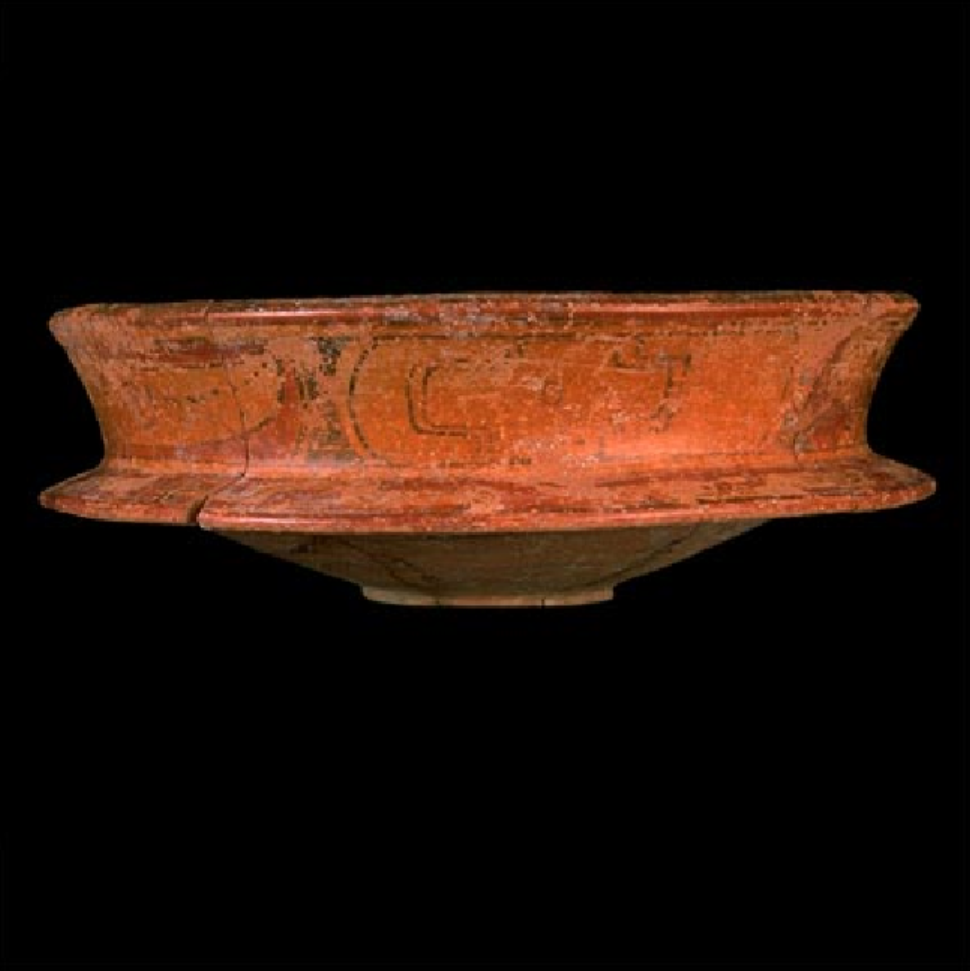
An Actuncan bowl with flared sides, basal flange, ring base, direct rim, and rounded lip. A polychrome design of two serpentine, well-endowed jaguars alternate with two large Kan crosses in a band above the flange. The basal flange itself (3.5 cm in width) is decorated with seven bisected Kan crosses, or portal motifs, arranged in alternating orientations. These motifs are red (10R 4/8) in color and are outlined in black (7.5R 2.5/0). The vessel was inverted over the skull of the individual.
Vessel: Actuncan Orange Polychrome: Actuncan Variety flanged bowl with ring base and kill hole.
Jar with a vertical neck, direct rim, rounded lip, and ring base. The height of the neck is 3.5 cm. The ring base is 1.5 cm high and has a diameter of 8 cm. The slip is red (2.5YR 4/8; 2.5YR 5/8) and was applied to the exterior and also to the interior of the neck. The medium-textured paste is a very pale brown (10YR 7/3) or grayish brown (10YR 5/2) with a 0.4-cm wide core.
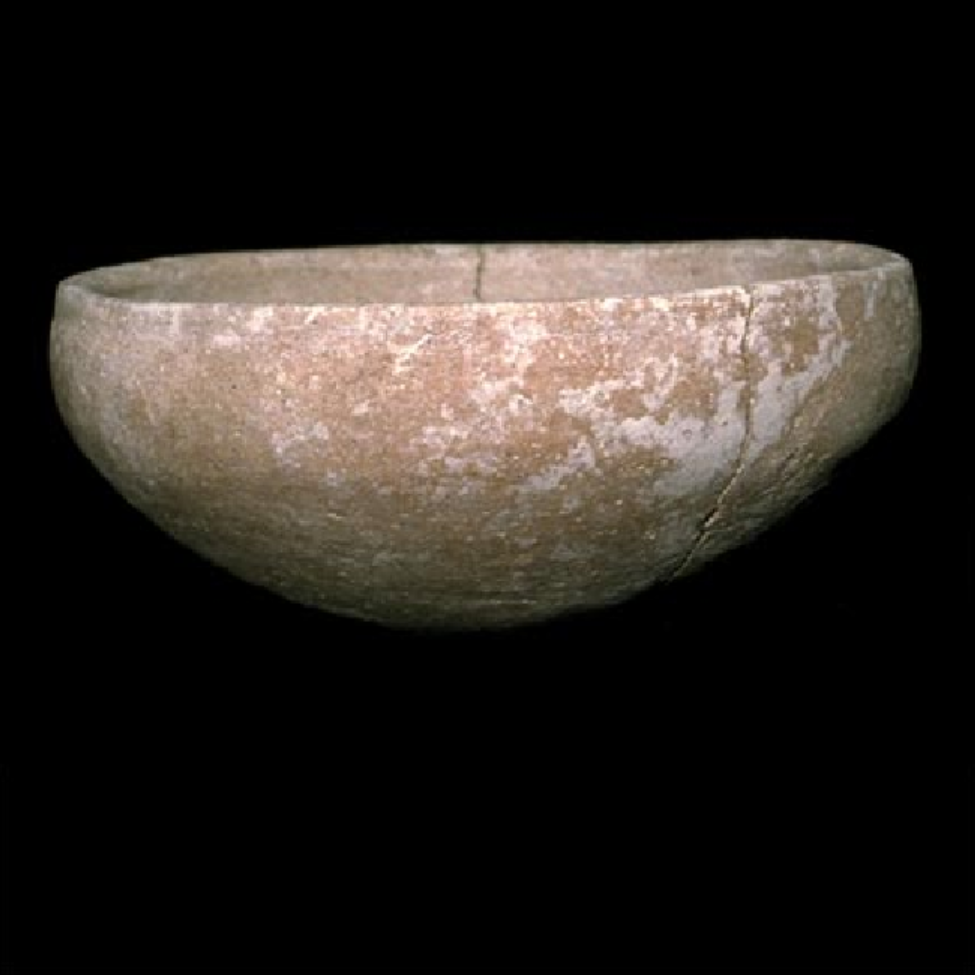
Eroded and basically stripped to the paste, the vessel now appears as a cream colored bowl with incurved sides, a flat base, and a direct rim with a rounded lip. The color is light gray (10YR 7/2), light brown (10YR 6/3), and gray (10YR 6/1). The thickness of the walls is 0.5 cm.
A rounded bowl with a curved base. The rim is direct and the lip round. An interior incised groove, 3.7 cm below the lip, stylistically separates the rim from the body of the vessel. The interior is slipped and the paste is yellowish red (5YR 5/8) with black and white inclusions. The walls are 1 cm thick. This bowl was inverted over the head of an adult.
A bowl with rounded sides and a direct, slightly folded rim. The interior was slipped in red (2.5YR 5/8), but none existed on the exterior surface. Wall thickness ranges between 0.5-0.8 cm. The bowl was inverted and placed over the head of an extended, adult burial.
A bowl with a rounded base and a shallow medial flange. The flange has a groove on the inside. The vessel is slipped in red (2.5YR 5/8) on the interior and has some fire clouding. Wall thickness is 0.5-0.7 cm and the rim is slightly folded. The vessel was found inverted over the head of an extended adult.
DOA No: 33/200-5:10 An Actuncan polychrome bowl with outcurved sides and a basal flange. It has a ring base, direct rim, and rounded lip. The ring base is 4 cm in height and 7.2 cm in diameter. Decoration of the vessel body consists of two red and black hummingbird designs alternating with two framed serpent head profiles on an orange base. The flange is 2.7 cm wide and is painted with stepped forms which, most likely, represent half of a portal motif. These are arranged in alternating orientations. Inside the vessel, there are red (1.4 cm wide) and black (0.3 cm) circumferential lines. The paste is pinkish gray and has a fine texture with some iron particles permeating the surface. There is some evidence for smoothing of the base. The vessel was inverted over the skull.
Vessel: Actuncan Orange Polychrome: Actuncan Variety flanged bowl with ring base and kill hole.