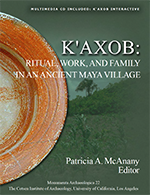
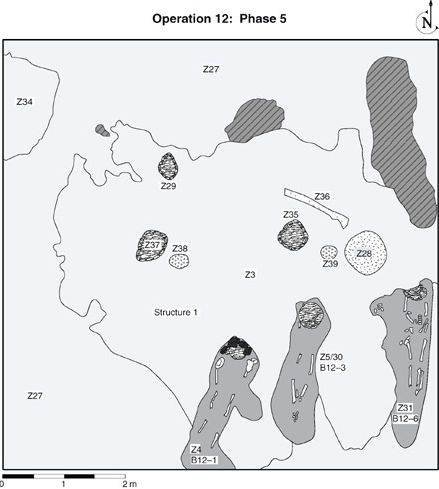
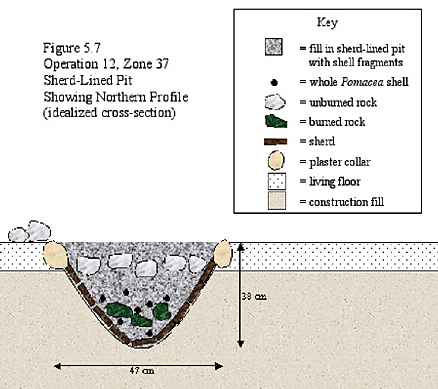
Along with small-scale production activities, ritual practice, and reproduction of the domestic unit, four additional trends bear mentioning because of their strong impact on the material remains of K'axob. They include (1) the close interdependence of ritual and mundane activities, (2) recurrent evidence of artifact recycling, (3) scarcity of "precious" materials acquired through long-distance trade connections, and (4) the intensive exploitation of local resources. The close spatial connection between ritual and food-preparation features is well illustrated by the sherd-lined pits and burials of operation 12. Construction phase 5 shows the outlines of an apsidal structure that contained three sherd-lined pits (zones 29, 35, and 37). In schematic profile view, the zone 37 pit clearly was lined with sherds and contained freshwater gastropods and burned rocks. Likely used for roasting and steaming foods, the sherd-lined pits are located only meters away from three extended Terminal Formative burials. This proximity suggests a spatial integration of activities that, in Western society, are relegated to very separate and spatially distinct realms.
Sherds were not only recycled as linings for cooking pits, however, many were shaped into a quadrilateral form and notched on two sides to serve as weights for a fishing net. Called net sinkers, the prevalence of this artifact at K'axob indicates the important role of fish in the diet of this village. For some types of pottery, sherds were added to the paste during pottery production as is apparent in this thin-section of a sherd from K'axob. Golden-yellow chert bifaces, imported from chert producers to the south of K'axob, also were subjected to protracted recycling efforts. After breakage rendered them unfit for agricultural tasks, fragments often were reused as cores (as in the image shown here). Finally, fragments of hard-stone metates made excellent "pot rests" or hearth stones and many were broken into cubes (as in the fragment shown here) and placed in proximity to a fire hot enough to produce oxidation and spalling. Taken together, this recurrent evidence of recycling indicates that K'axob residents used all conceivable means to extend the use of their raw materials.
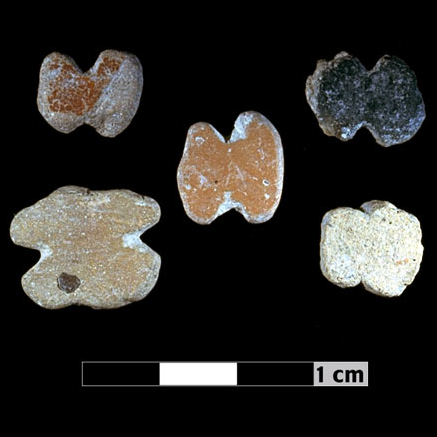
Five net weights from Operation 1.
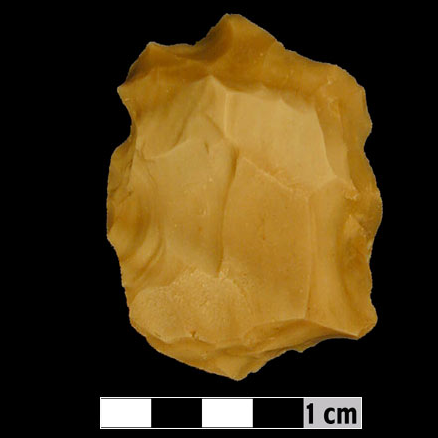
Reworked chipped stone biface from Operation 8, Zone 1, LT# 0001.

Profile view of metate fragment from Operation 11, Zone 2, GT #042.
At K'axob, "precious" materials such as jadeite (or greenstone) and obsidian were scarce. The paucity of materials acquired through long-distance trade suggests that localized exchange networks predominated. The Guatemalan highlands and Motagua valley--respective sources of obsidian and jadeite--were very far from the world of Formative K'axob residents. Jadeite occurred primarily as single occurrences of small beads in burial contexts while the sharp-edged volcanic glass is present in very low frequencies and principally as small fragments of prismatic blades.
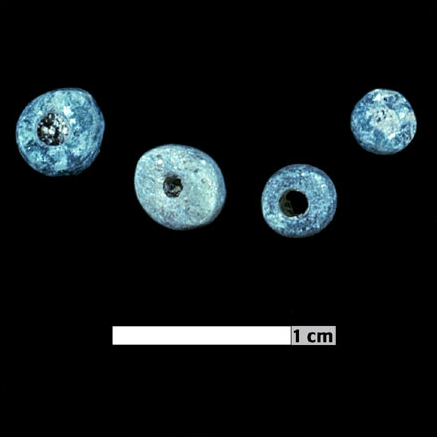
Four greenstone beads from Operation 1: (L-R) Z220 (paleosol), Z59 (midden), Z80 (Burial 1-12a), and Z233 (Burial 1-43).
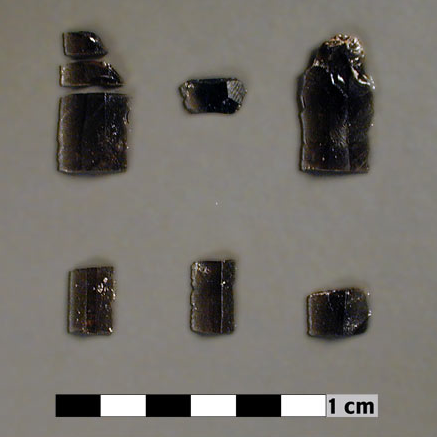
Obsidian from the Chaakk'ax complex, top row, blade fragments from the Early Chaakk'ax (Op 1, Z59; Op 1, Z59; and Op 1, Z58). The first blade is San Martin Jilotepeque obsidian. Bottom row, blade fragment from Chaakk'ax (Op 1, Z57) and two from the Late Chaakk'ax (Op 1, Z56 and Op 1, Z160). The first and third blades on the bottom row are from San Martin Jilotepeque. (Top OB #012, OB #030, OB #029; Bottom OB #106, OB #057, and OB #091)
In contrast to the low frequency of long-distance imported goods, local resources were intensively exploited. Mary Lee Bartlett's analysis of local clays and pottery pastes indicates that during the Late Formative period, most pottery was made from locally available materials. Local food resources, likewise, were harvested in large quantities. When Marilyn Masson and Ryan Harrigan analyzed the animal bone and shell remains, they found thousands of freshwater fish and turtle bones as well as mollusc shells from locally available aquatic species. These remains reinforce the overriding importance of the wetlands and the nearby river to the inhabitants of K'axob. Arguably, K'axob Maya framed their lives within a very local existence and within that world, they seem to have prospered and fared well.
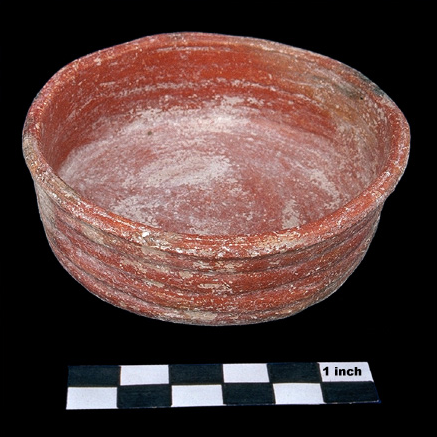
Sierra Red: Gadrooned variety, one of four upright vessels of the quadripartite cache, Operation 1, Zone 77.
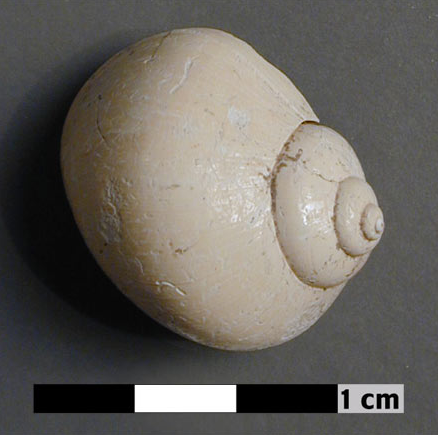
Unworked Pomacea flagellata (juvenile).
This concludes the tour of K'axob and the introduction to the place, the researchers, and the themes that have emerged from our field research. Much more can be learned about the material remains of K'axob by perusing the illustrated databases, the 3-D excavation module, and the accompanying book.
Previous page
Reuse
Copyright holder: Patricia A. McAnany
License: Attribution-NonCommercial-ShareAlike 4.0 International (CC BY-NC-SA 4.0)
Recommended citation:
McAnany, Patricia A., 2004. Tour for K'axob: Ritual, Work, and Family in an Ancient Maya Village. Version 2. Cotsen Institute of Archaeology Press. https://doi.org/10.25346/S6/JYWFSW
Download data: tour.zip