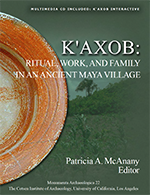
Ritual activity took place in the residence and adjacent plaza spaces and is most conspicuously displayed in caches and burials. During the Late Formative period, plaza spaces were sometimes dedicated by the burial of two pottery vessels, one inverted over the other. In one case, three pieces of limestone--evocative of the 3 hearth stones mentioned in Maya creation narratives--were placed in the lower, upright vessel. The cosmic significance of numerical groupings of triadic and quadripartite elements also structured cache deposits as can be seen in the color-coded "threesomes" of small figurines and shells of a Terminal Formative cache (elements of this cache are shown here in triadic arrangement but they were found in a small cluster at the base of a vessel). A quadripartite structure can be clearly discerned in the arrangement of 4 small pottery vessels in a Late Formative cache (northern vessel removed, south vessel and rims of underlying east and west vessels visible). During the early facet of the Early Classic period, the construction of a raised platform was dedicated with a deposit of two complete stemed macroblades and one distal biface fragment.
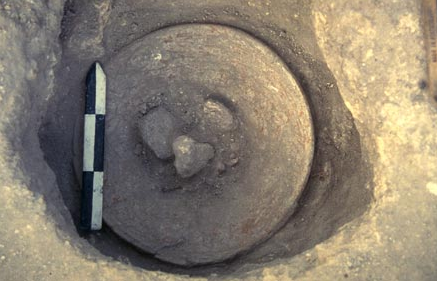
Cache deposit showing lower, upright vessel of lip-to-lip cache with three stones, Operation 10, Zone 9a, Construction phase 3.

Cache deposit of shell and greenstone objects found inside of upright Vessel #025; arrangement shows triadic schema of contents, Operation 1, Zone 17, Construction phase 9.
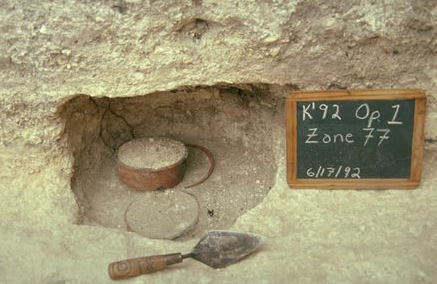
Cache deposit of four vessels arranged in a cruciform pattern. Top southern vessel (V# 030) is visible in photo and the rims of lower east-west vessels (V #035 and V #032) can be seen, Operation 1, Zone 77, Construction phase 8c.
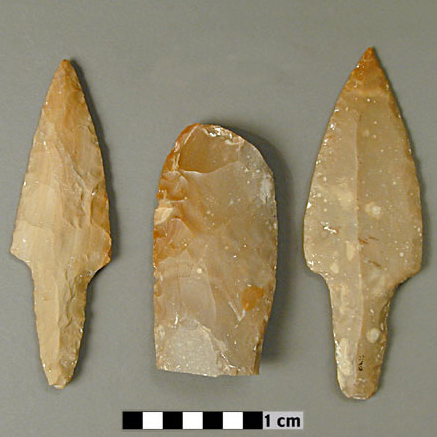
Lithic cache of two stemmed macroblades and a distal biface fragment (LT #0022, LT #0026, and LT #0023), Operation 7, Zone 6a.
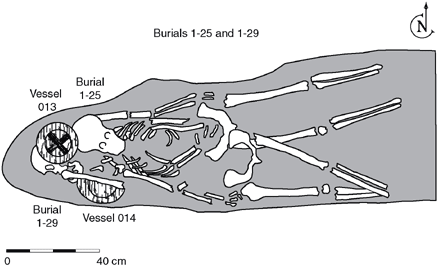
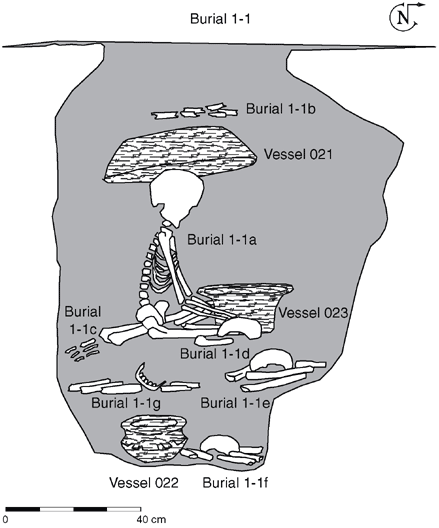
At K'axob, mortuary ritual was a domestic affair and many, but not all, deceased family members were interred in burial pits under the floors of domiciles and plazas. The earliest ancestors tended to be placed in an extended position and often more than one were interred together. In operation 1 (Burials 1-25 and 1-29), two males were buried together along with two small Sierra Red bowls, each with a painted cross on their base. This earliest known case of the painted cross at K'axob was soon followed by several more interments that prominantly featured a vessel with a painted cross, such as Terminal Formative Burial 1-1 in which a central, seated male was interred with the secondary remains of six other individuals.
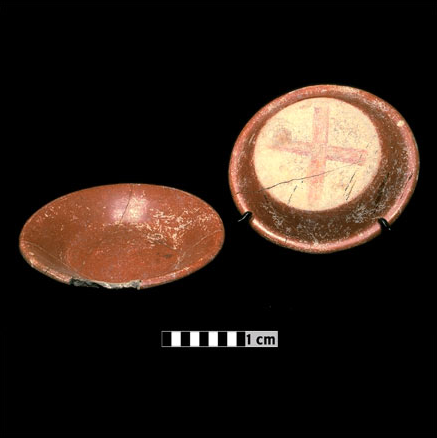
Two shallow Sierra Red dishes, both with crosses painted on their exterior bases. Left vessel is 013, right is 014.
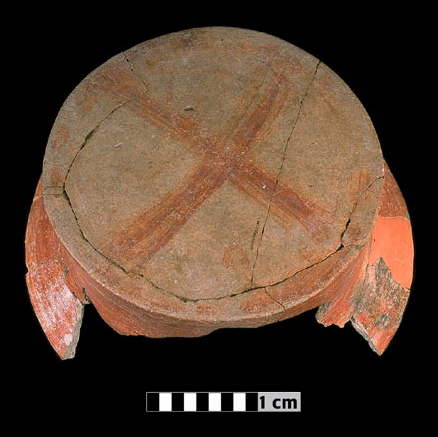
Society Hall Red: Society Hall bowl with a cross painted on the exterior base, Operation 1, Zone 15g.
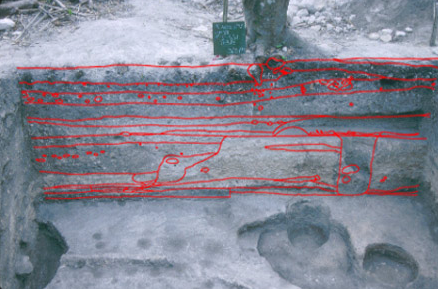
Continuity of the family was anchored materially in mortuary rituals conducted at the domicile. Ancestral interments at these locales signified both termination of life (and perhaps of a generation) and a renewal that was expressed through the expansion and refurbishing of a domicile which often followed on the heels of a burial event. This sequence of events can be "read" in the stratigraphy of our excavations. For example, the placement of Burial 11-4 terminated the use of the phase 5 floor of operation 11. Apparently, new construction commenced immediately as the deceased was placed in a very shallow depression and was covered only by the construction fill of the subsequent phase. At operation 11, variations on this pattern were repeated many times over a period of approximately 800 years, yielding a total of 8 construction phases and 13 burial interments. In cross-section, this pattern of repeated domicile refurbishing and ancestral interment yielded well stratified and richly textured chronicles of domicile construction.
Previous page | Next page |
Reuse
Copyright holder: Patricia A. McAnany
License: Attribution-NonCommercial-ShareAlike 4.0 International (CC BY-NC-SA 4.0)
Recommended citation:
McAnany, Patricia A., 2004. Tour for K'axob: Ritual, Work, and Family in an Ancient Maya Village. Version 2. Cotsen Institute of Archaeology Press. https://doi.org/10.25346/S6/JYWFSW
Download data: tour.zip